International access between the United States and Canada expanded with the long-awaited opening of the new Gordie Howe International Bridge that now spans the Detroit River, connecting the heart of the Motor City with Windsor, Ontario.
Before the opening of the new bridge, travelers between the United States and Canada in this region would use the Ambassador Bridge above the river or the Detroit-Windsor Tunnel underneath it. While both of those remain travel options, this marks the first new crossing between Ontario and Michigan in over six decades.
The Gordie Howe International Bridge opened to further connect the two North American nations and operates 24/7. Spanning 1.5 miles (2.5 kilometers), the construction of the bridge was a $4.5 billion ($6.4 billion Canadian) project that has 6 total lanes of traffic, 16 toll lanes and 60 inspection lanes – 24 in Canada, 36 in the U.S. There's also a multi-use path for pedestrians and cyclists (opened Aug. 5, 2026), one of plenty of unique features on the bridge and nearby for first-time visitors and frequent travelers alike.
The landmark bridge is more than just a nod to the expansive North American trade that runs across the River and symbol of a longstanding economic relationship. The land on which the bridge was constructed also has deep Indigenous roots.
It is also a hub for commuting, tourism and leisure. So whether you're headed to the office, looking for phenomenal local dining, entertainment, sports or outdoor activities, or just passing through to get to a destination beyond, the bridge was built to serve your needs. Here's what to know about crossing the Gordie Howe International Bridge, and the many must-see attractions on both sides of the Detroit River:
What to have and policies
Motorists reach the bridge via Interstate 75 in Detroit and Highway 401 in Canada.
When traveling across the bridge, it's important to make sure to have valid travel documents for U.S. border entry and Canadian border entry.
Travelers headed to Detroit can find the U.S. Customs and Border Patrol guidelines here. Those headed to Windsor can find the Canada Border Services Agency information here.
Whether crossing via vehicle, or on foot or bicycle via the multi-use path, travelers must have: a valid passport, passport card, NEXUS card, or an Enhanced Driver's License.
Like with any U.S.-Canada border entries, do not bring prohibited substances, weapons, raw produce and other items listed in guidance.
Bridge speed limit is 35 miles per hour (or 60 kilometers per hour). You cannot stop on the bridge for photos.
The cost
Keep in mind toll costs for crossing via vehicle.
Standard small and medium-sized passenger vehicles, even with items attached to the roof, cost a flat rate of $5.75 ($8.00 Canadian). Towing trailers costs extra.
Larger passenger vehicles and commercial vehicles are charged $8.75 ($12.00 Canadian) per axle.
The bridge website has an online toll calculator that can be found here. Frequent vehicle travelers can also think about signing up for a Breakaway account, a toll discount program, for discounted rates and an easier travel experience.
The bridge has manual, automatic and electronic tolling lanes.
Bridge features
The historic infrastructure project owned by Canada and Michigan was a massive undertaking, completed after 8 years of construction and decades of planning in the making. It pays homage to Gordie Howe, a Canadian professional hockey player who spent 25 seasons on the ice with the stateside National Hockey League team, the Detroit Red Wings, winning four Stanley Cups with them. The legendary athlete, nicknamed "Mr. Hockey," was beloved by both the U.S. and Canada and represented unity across the water.
Upon completion it became the longest cable-stayed bridge in North America, with 216 stay cables. It is 123 feet (37.5 meters) wide.
The shape of the two bridge towers, which are 720 feet (220 meters) tall, are a nod to the curvature of a hockey stick in a slap shot, further commemorating Howe. At its highest point, the bridge deck sits 150 feet (46 meters) above the Detroit River.
Bridge leadership developed the Visual Art Program complete with public, commemorative and neighborhood art to pay homage to the area's rich historical past and vibrant surrounding communities today.
On the Canadian Port of Entry, you'll pass by a black oak savannah and tallgrass prairie landscape, and a First Nation art piece. On the U.S. Port of Entry, find 30 acres of landscaping, a 100-foot buffer with vegetation and a public path.
The bridge has electronic payment options, on-site weather monitoring, travel time detection systems to indicate border wait time, and other tech designed to expedite traffic and make travelers' experiences easier.
The Bridge does not currently have amenities such as a duty-free shop or gas station.
Multi-use path
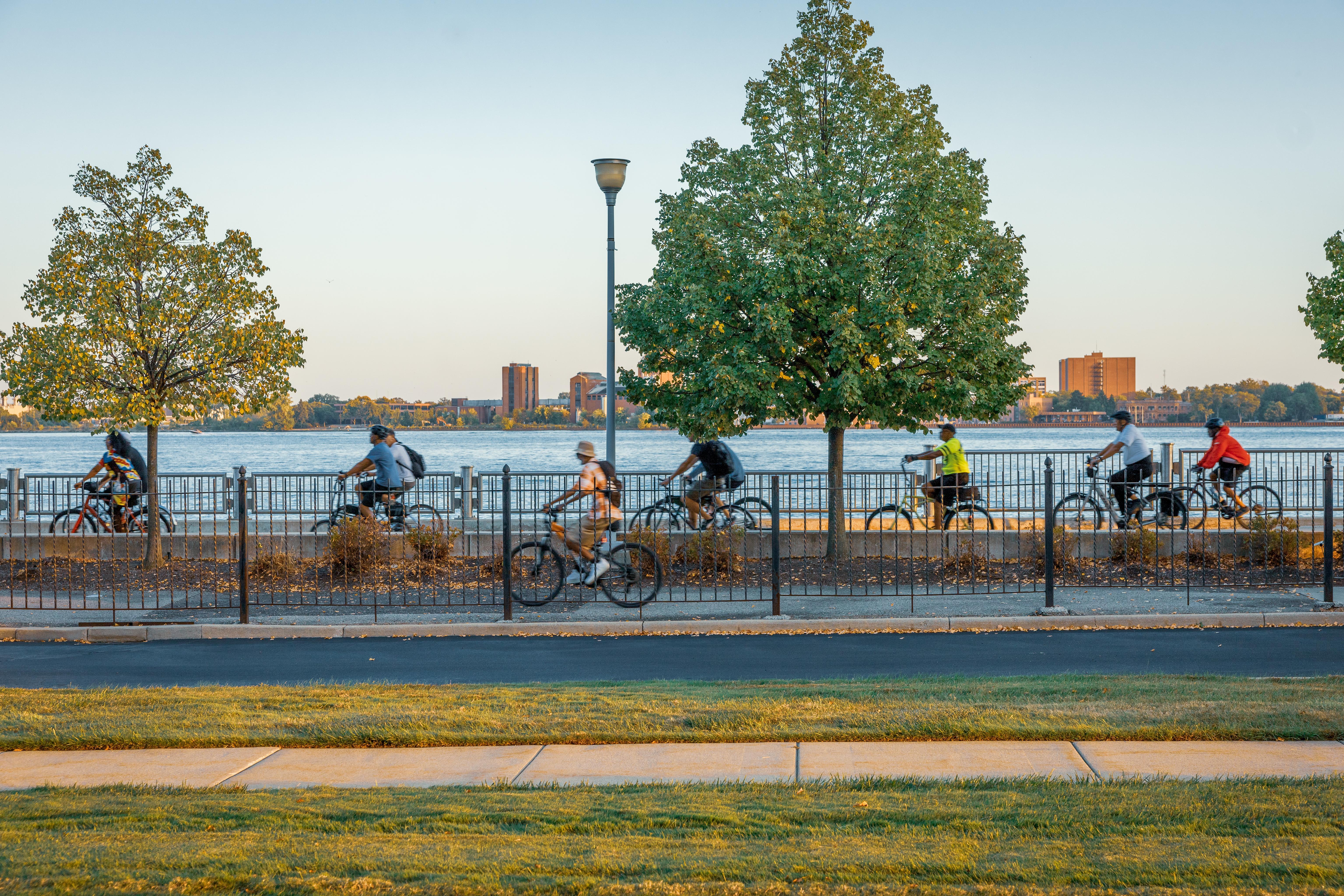
One major highlight is the bridge's pedestrian and cyclist path, separate from vehicle traffic. It's nearly 12-feet wide and allows for unparalleled recreation and expansive views of both skylines. The total length of the multi-use path journey is 1.8 miles (3 kilometers) one way, with a 5% incline. It takes about 45 minutes to walk, or 20 minutes by bike.
The green surface is skid-resistant and retro-reflective, according to the site. There are no areas for rest or seating along the pathway. Bridge authorities suggest planning your visit around daytime hours, and recommend keeping an eye on weather-related updates and possible closures.
There is no charge for pedestrians or cyclists using the path to cross the Detroit River, but visitors do still need their valid travel documents as they will also be required to go through border processing.
Visitors can't park on-site at either port of entry.
But in Windsor, you can access the entrance at 4389 Sandwich Street, and parking is available at the Malden Park trailhead about 1.9 miles (3 kilometers) from the path's starting point.
The path there connects to the Trans Canada Trail, Malden Park, Sandwich Towne, the Great Lakes Waterfront Trail – a 2,250-mile (3,600 kilometer) recreational route connecting 170 communities, First Nations, and four of the five Great Lakes – and the Riverfront Trail.
On the Detroit side, travelers can access the path entrance at 6366 West Jefferson Avenue. You can park nearby at the Clark Park trailhead, about 1.6 miles (2.6 kilometers) from entry.
In Detroit, the multi-use path connects to the Detroit Riverwalk, the Iron Belle Trail – known as Michigan's showcase trail – the planned Joe Louis Greenway, and the soon-to-be-interconnected regional network of greenways and blueways, Great Lakes Way.
Nearby Detroit outdoor attractions
There are plenty of nearby attractions on the Detroit end of the bridge, whether you are coming into the Motor City or headed across the bridge from it.
In addition to the connected trails, be sure to visit the new Ralph C. Wilson Centennial Park. The Park is a short drive from the entrance of the bridge and offers a 22-acre green space complete with walking paths, scenic seating options, a fun-filled play garden, a seasonal Water Wonderland attraction and more.
Continue your visit to the city by walking further along the must-see Detroit Riverfront, which spans about 4 miles and includes other highlights such as the Dequindre Cut Greenway, a nearly 2-mile long recreational pedestrian and cyclist path below-grade, surrounded by urban artwork and complete with summer entertainment.
The Dequindre Cut connects the Detroit Riverfront to Eastern Market, another must-see stop in the city. Produce vendors, local artists, small businesses and more create the unique hustle and bustle around Eastern Market every Saturday and even during certain weekdays, making it the largest outdoor farmers market in the U.S. Take in the smells of fresh fruits, vegetables and flowers, hear the sounds of a variety of talented musicians, and enjoy the tastes of restaurants in and around the market.
Back at the Riverfront, Milliken State Park and Harbor is a well-known spot for its fishing, picnicking and a landscaped berm area.
Further along, Belle Isle is an island in the Detroit River popular for biking – it has a 5.8 mile long loop – wildlife-viewing, nature-trailing and beach recreation. It is also home to the historic Belle Isle Aquarium and the Anna Scripps Whitcomb Conservatory.
Anywhere along that route is sure to offer incredible views of the city – and of Detroit's neighbors to the South.
Detroit dining and entertainment
Luckily, if you're coming from the Bridge, you also won't be too far from the vibrant Southwest Detroit neighborhood and Mexicantown community, where you will be sure to find authentic cuisine from a host of local restaurants and bakeries. Latin and Central American food make for some of the area's best fares, often from family-owned establishments that have been there for decades.
One highlight is Honey Bee Market, where you'll find a unique selection of goods unlike anywhere else in Detroit. But don't just stop at local eats. The area is highly walkable, which is convenient to see the neighborhood's many murals and public art.
The nearby Corktown neighborhood features a number of other dining establishments, bars and shops, accented by unique cobblestone surfaces. Detroit's oldest neighborhood and historically Irish, Corktown has become a trendy and growing part of the city. Find everything from the Batch Brewing microbrewery, to the Sugar House cocktail bar, to Grandma Bob's Pizza and beyond.
For those looking to catch a show while in Detroit, the city has several theatre and performing arts centers including The Fox Theatre, the Detroit Opera House, the Detroit Symphony Orchestra and more, all of which present a variety of acts and genres for all different audiences and family fun.
And for those wanting to see one of Detroit's professional sports teams, Ford Field, Little Caesars Arena and Comerica Park are close by for fans to enjoy the Lions, Tigers, Red Wings or Pistons.
Other historic Detroit spots
You can't miss the iconic Michigan Central train station, too. After a massive, yearslong restoration project, the historic station re-opened in 2024. It's now a major hub for tech companies, community events and even just casual visiting – all are welcome to explore the site's impressive architecture and renovation through tours or on their own. Outside the landmark, you'll find the expansive Roosevelt Park.
You also won't be far from other key Detroit-area pillars.
The rich cultural and entertainment district of Greektown has just undergone a $20 million renovation. Another pedestrian-friendly pocket of Detroit, Greektown is hopping with restaurants, bars and entertainment.
Hamtramck, Detroit's "World in Two Square Miles" neighborhood, is home to Polish, Yemeni, Bangladeshi and many more immigrants, making the area a melting pot of cultures, languages and cuisines.
The same goes for Dearborn, home to a large Muslim and Arab-American population – be sure to try late-night Yemeni coffee shops or local bites. Dearborn's food culture is especially notable given it has one of the nation's largest concentrations of halal restaurants.
Historic Fort Wayne is also around the corner. The site, open daily and managed by Detroit's Parks and Recreation Division, is a crucial part of the city and nation's history. Originally home to many Indigenous communities native to the Great Lakes, construction of the Fort itself began in 1842 and became a key post throughout many national and global conflicts. More recently, the Fort is visited as an important cultural heritage site.
Want to see more history at museums? Check out the Detroit Institute of Arts, the Detroit Historical Museum, the Charles H. Wright Museum of African American History, the Henry Ford Museum or the Motown Museum for comprehensive looks into heritage, art, music and culture.
Where to stay and how to get around in Detroit
Detroit has plenty of accommodations if you are planning to stay in the city or nearby.
For those looking for a swanky, upscale boutique stay, consider the Siren Hotel, Shinola Hotel, ROOST Detroit or Hotel David Whitney, all in the heart of downtown and within walking distance of the major stadiums, theaters, dining and other tourist attractions. For accommodations closer to the Detroit River but still downtown, look no further than the Fort Pontchartrain Wyndham Hotel or Detroit Foundation Hotel.
For travel convenience, hotels closer to Detroit Metro Airport in Romulus, about a 25-minute drive, are also plentiful.
Check out this guide for places to stay in the broader metro area: https://visitdetroit.com/inside-the-d/metro-detroit-hotels/.
For those who want to get around without driving downtown, try out the free Qline streetcar that travels 3.3 miles up and down Woodward Avenue. The People Mover, which is a circular, elevated rail service, is also free to ride and has 13 stations located conveniently around downtown. The Detroit Air Xpress is an affordable and reliable bus route between the airport and downtown.
Nearby Windsor outdoor attractions and more
Be sure to also visit any number of local Windsor attractions, including outdoor areas.
The City of Windsor has 206 parks spanning 2,500 acres of green space, all of which offer gardens, fountains, picnic areas, sculptures and recreation.
The Ojibway Prairie Complex includes six natural sites that bring together vast vegetation, habitats for wildlife, beautiful landscapes and more all within 10 minutes from downtown Windsor.
The Ojibway Nature Centre and Park is open for walking, birding and cycling. It connects to the Windsor Riverfront Trail, one of a network of recreational trails across Canada (the Trans Canada Trail, which is 18,600 miles – 30,000 kilometers – of greenways, waterways and paths) that offers incredible views.
The Windsor Riverfront's Sculpture Park is a must-see public outdoor art gallery. Enjoy scenic views while exploring a unique contemporary art collection.
Soak in the beautiful, natural Lake Erie shoreline at the Holiday Beach Conservation Area, and take in the sights over a picnic, nature walk, nice swim or even a night camping.
If you'd like to get a taste of Canadian history instead, you'll see rare vintage aircraft restorations and other unique memorabilia at the Canadian Aviation Museum, appropriately located at the nearby Windsor International Airport.
The Chimczuk Museum is a nod to the city's vast background, with exhibits on Indigenous peoples, the Underground Railroad and local Black history, geologic history, wartime and more.
In Amherstburg, the Fort Malden National Historic Site provides a look into the country's early military history.
Nearby Windsor nightlife and wineries
Downtown Windsor has an active nightlife, including at the notable Caesars Windsor Casino, where guests are sure to find gaming, excellent dining, live entertainment and a luxurious stay. The adults-only indoor pool is a sure feature to remember; it overlooks the Detroit River and skyline.
Outside of the casino, there's no shortage of fun bars, nightclubs, pubs and lounges in Windsor. Check out Maiden Lane, ekō, Blind Owl, and Sandwich Brewing Co., just to name a few.
Downtown Windsor is also a short drive from several local wineries, whether you're just looking for a taste or you're a true wine aficionado.
Wagner Orchards & Estate Winery or Sanson Estate Winery are among the closest, but nearer to Lake Erie are Muscedere Vineyards, Sprucewood Shores Estate Winery, Erie Shore Vineyard, Paglione Estate Winery and plenty more.
Where to stay and how to get around in Windsor
Of course, Caesars Windsor comes to mind as an excellent downtown option to stay, but if the casino isn't your focus, there are also plenty of other options right on the River.
Consider the DoubleTree by Hilton Windsor Hotel & Suites, the Holiday Inn Express Windsor Waterfront or the Best Western Plus Waterfront Hotel for skyline views while still being short distances from some of Windsor's best parks and entertainment.
Walkerville is a place to stay outside of the downtown hustle, and has a more local, historic feel to it where you'll find boutique shops, craft breweries and a variety of food options.
For visitors in need of public transportation options, consider the Transit Windsor bus system.
EXPLORE MORE

Trailblaze Detroit: The Perfect Day Trip Crossing the Gordie Howe International Bridge’s “Multi-Use Path”
Best outdoor things to do in Detroit and Windsor by crossing the Gordie Howe Bridge

Exploring Southwest Detroit: Where Old Traditions Inspire New Flavors
Rooted in tradition, Southwest Detroit honors generations of immigrant culture while welcoming a fresh wave of culinary creativity and growth.

Where to Go in Corktown Detroit: Best Spots Near the Godfrey Hotel & Michigan Central Station
Best Places to Eat, Drink & Explore