
From pre-Revolutionary War battleground sites to world renowned museums that commemorate the men and women who have died in battle, Metro Detroit has countless war stories to tell.
There are sites where Native Americans and early European settlers clashed, monuments that pay homage to Civil War soldiers, and museums that let you board wartime aircraft, all within a half-hour of downtown Detroit.
Here are just some of the sites where war stories waiting to be heard again:
Battle of Bloody Run, Detroit
One of the most violent battles ever fought on Michigan soil took place on what is now the city’s east side. The Battle of Bloody Run preceded the Revolutionary War by more than a decade. A Michigan historical marker at 3321 East Jefferson Ave. marks the location, near the present-day Elmwood Cemetery.
It was part of what is now called Pontiac’s War, when Chief Pontiac led an alliance of several Native American tribes in a siege on the British Fort Detroit (Fort Pontchartrain du Detroit, see below) in 1763. About 260 British soldiers crossed Parent’s Creek when Chief Pontiac’s attacked. It’s said the creek ran red with blood, and the creek became known as Bloody Run.
Battle of Monguagon (Maguaga), Trenton
A Michigan historical marker at the west entrance into Elizabeth Park commemorates the approximate location of the War of 1812’s Battle of Monguagon. The battle ignited when roughly 600 American troops planning to transport supplies from present-day Monroe to Detroit encountered an army of about 400 British and Native American soldiers.
Pro Tip: To see remnants of Hull’s Trace, the road of logs that helped troops travel between Detroit and Ohio, take a short drive south from Elizabeth Park on West Jefferson Avenue and look for the historical marker alongside the road.
Grand Army of the Republic Building, Detroit
These days at the Grand Army of the Republic (GAR) Building in Detroit, you can enjoy an upscale meal at Sexy Steak or book the multi-level Castle Hall private event space. But decades ago, the castle on Grand River Boulevard and Cass Avenue downtown served a different clientele: Civil War veterans.
Built in 1899, the building served as a clubhouse for the “Boys in Blue” who survived the war - and a memorial to those who didn’t. If you’re touring downtown Detroit from the People Mover, you can’t miss the castle as you near the Times Square and Grand Circus Park stops.
Historic Fort Wayne, Detroit
One of Detroit’s most recognized historic military sites never actually saw armed conflict. Historic Fort Wayne, located on the Detroit River in southwest Detroit, was originally constructed in 1845 as concerns grew of a U.S. conflict with Canada. Much of the original facility, including the limestone star-shaped fort and the barracks built in 1848, still stand, and are available to tour.
Once an important Native American trading post, gathering spot and burial ground, the land on which Fort Wayne was built became a training facility for Union troops during the Civil War. Decades later, it was a logistical cog in Michigan’s “Arsenal of Democracy” during World War I and World War II. And during the 1960s and ‘70s, the fort served as a processing location for Vietnam War draftees.
In the shadows of the new Gordie Howe International Bridge, Historic Fort Wayne offers guided tours most Saturdays at 1 p.m. The fort is located at 6325 W. Jefferson Ave., in Detroit.
Michigan Flight Museum, Ypsilanti
This Smithsonian-affiliated museum located in suburban Detroit about 25 miles from downtown gives visitors rare access to historical aircraft dating as far back as World War I. The ever-changing exhibits currently include “Michigan’s Ambassador in Blue: A Thunderbird Story,” which tells of the life of Col. Doug Roach, a war hero from nearby Romulus.
An exhibit called “Deep Landings” is an immersive experience that highlights the danger, sacrifice and determination of U.S. Naval and Marine aircraft carrier pilots from World War II to present day. Visitors can try one of the flight simulators, including a new Virtual Reality simulator.
Currently on display at the museum are aircraft such as an AV-8A Harrier, which revolutionized the military with its vertical takeoff and landing capabilities, and a KC-135 cockpit. Other standalone exhibits pay tribute to the many aircrafts in service during World War I, World War II, and the Vietnam War. The Michigan Flight Museum is open daily until 4 p.m. The museum is closed Mondays.
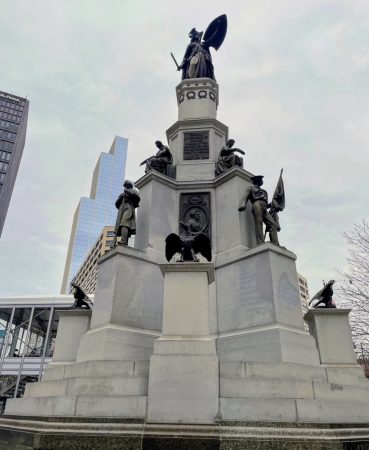
Michigan Soldiers’ and Sailors’ Monument, Detroit
The original bronze and granite statue that towers more than 60 feet above Campus Martius Park was unveiled in 1872. Some portions were later added in 1881. Created by famed sculptor Randolph Rogers, the Michigan Soldiers’ and Sailors’ Monument feature four bronze eagles that symbolize America and freedom, and four 900-pound statues that represent the four branches of the U.S. military.
Look closely to see bronze medallions of Union leaders during the Civil War, such as President Abraham Lincoln, General Ulysses S. Grant, and General William Tecumseh Sherman. The Native American queen perched atop the statue represents a strong, proud and brave State of Michigan, and the black woman symbolizes the victory of Emancipation
Selfridge Air National Guard Base, Harrison Twp.
Born as Selfridge Field in 1917 when the United States entered World War I, Selfridge Air National Guard Base in suburban Detroit is one of the oldest continuously operating military airfields in the country. The base has provided a home to units from all five branches of the Armed Forces.
On the base, the Selfridge Military Air Museum offers guided tours that detail the history of the facility and give visitors access to a large field of aircraft, many of which you can climb aboard for an up-close look.
Selfridge Air National Guard Base is located in Harrison Township, about 30 miles northeast of downtown Detroit. Entry into the museum costs $10 for adults, $8 for seniors and military veterans, and $5 for children aged 4-17. The museum is open Friday, Saturday and Sunday from 11 a.m. to 5 p.m. through Oct. 31, 2026. For information on group tours of 10 people ormore, call 586-239-5035.
Tuskegee Airmen National Historical Museum, Detroit
The first Tuskegee Airmen Museum in the United States was located at Historic Fort Wayne in the 1980s, built to honor the country’s first black military pilots who shattered racial barriers when they battled in World War II.
The museum collections are now on display at the Coleman A. Young International Airport on the city’s east side, giving visitors a history lesson on the legacy of the airmen and the aircrafts they flew. The museum is located at 11499 Conner St. in Detroit and is open daily to visitors. Call 313-843-8849 for more details.
Explore More

Discover Detroit’s labor landmarks and learn how the working class shaped the Motor City’s history…

Detroit has an undeniably rich, diverse, and globally significant history. From Motown to the automotive…

Detroit’s iconic landmarks are more than just sights—they’re stories woven into the city’s rich history…